New York-Style Pizza
Jul 26th, 2008 by SteveB
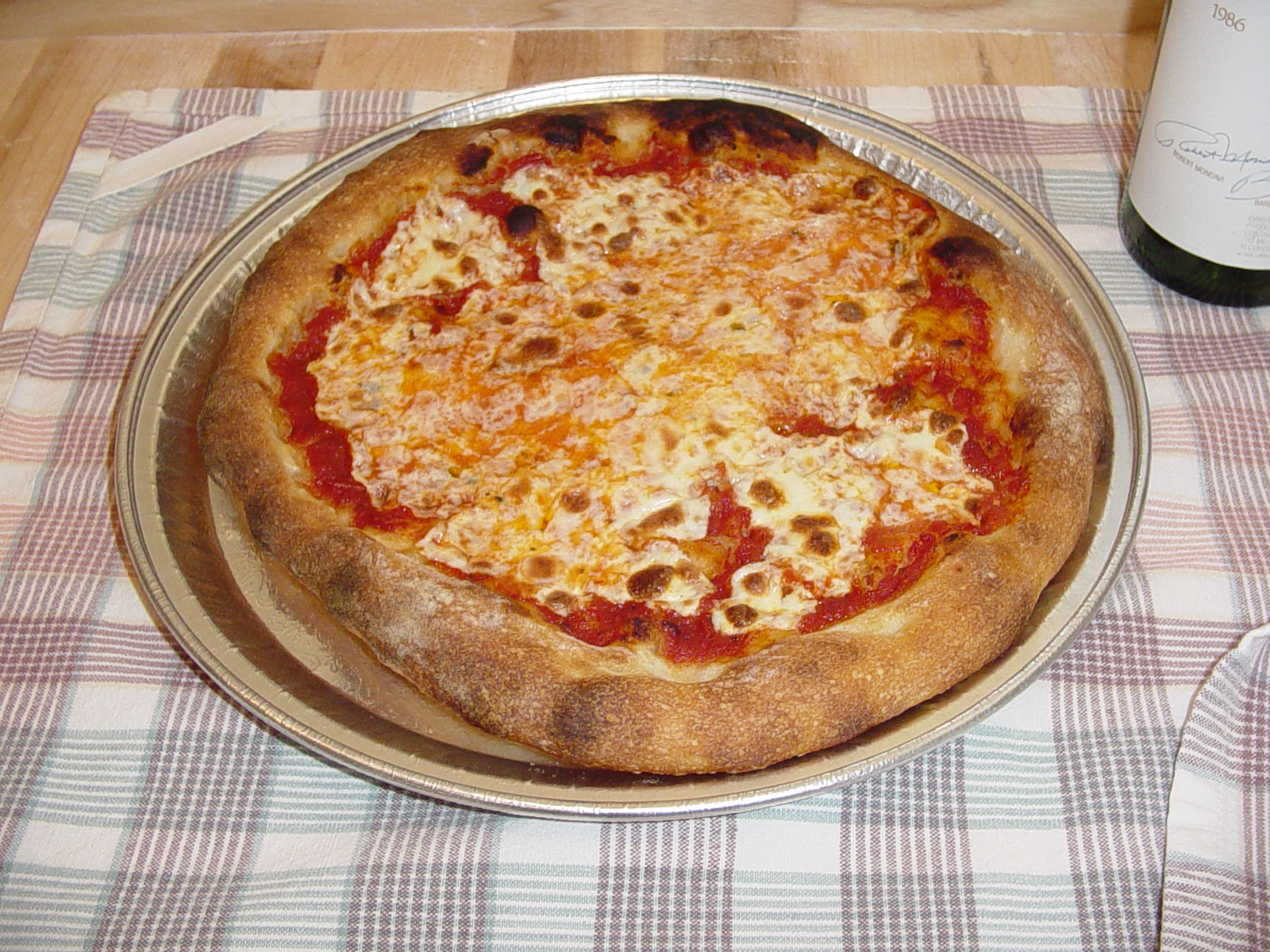
Whether it be the crisp, light crust of an authentic Neapolitan, the thick, focaccia-like crust of a Sicilian or the crunchy, chewy crust of a New York-style, pizza is one of the few foods that is almost universally loved. As a “breadie”, I judge the quality of a pizza by its crust; the texture of the crust should be appropriate to the style of pizza being made and the flavor of the crust should be able to stand on its own, even without the, dare I say, “distractions” of the toppings. If the remnants of a pizza repast are littered with uneaten crust, then great pizza was not served.
The formula detailed here uses a sourdough preferment to give a flavor profile to the crust that is just right to my taste. I encourage you to play around with the formula to adjust the flavor to your liking. An extremly useful tool to help in your experimentation is a Preferment Pizza Dough Calculator, which can be found on the Pizza Making forum.
To get the desired chewy texture, King Arthur Sir Lancelot high gluten flour is used. Because of the high gluten level, this is one of the few times where I find a stand mixer to be necessary to fully develop the dough.
Final Dough (makes two, 14″ pizzas)
- 455 g King Arthur Sir Lancelot flour
- 290 g Water
- 10 g Salt
- 1/2 tsp. Instant Dried Yeast
- 105 g Sourdough Starter (50% hydration)
- 10 g Olive Oil
Pizza Sauce (from Artisan Baking Across America)
- 28 oz. can Italian Crushed Tomatoes
- 1 tsp. Dried Oregano
- 1 clove Minced Garlic
- 2 tbs. Extra Virgin Olive Oil
- Salt to taste
Pizza Cheese
- Mozzarella (fresh or low-moisture), cut into 1/2 in. dice. If available, mozzarella di bufala (made from water buffalo milk) is highly recommended.
The night before making the pizzas, place all the ingredients of the final dough in the bowl of a stand mixer and mix on low (speed 2 on a KitchenAid mixer using the spiral dough hook) until the dough is fully developed, about 17-20 minutes. Divide the dough into two equal pieces by weight and shape each piece into a small, tight boule. Place each boule into a lightly oiled, round container, cover and refrigerate overnight.
The next day, take the dough out of the refigerator and let warm to room temperature for one hour.
To prevent the crust from drying out during baking, it is best to bake the pizza quickly at as high a temperature as possible. For this reason, while the dough is warming, I configure my gas oven specifically for pizza making. To do this, I place my oven rack at its uppermost level, bringing my baking stone to within inches of my oven’s broiler. This way, after the oven has pre-heated to its highest temperature (a bit over 500°F), I can turn on the broiler to heat my baking stone to an even higher temperature. The broiler is then turned off right before baking. This gives the pizza a nice crisp crust. Or course, it also makes the pizza that much harder to load into the oven. For this pupose, I use a SuperPeel. The SuperPeel is the closest I’ve seen to a home version of a baker’s oven loader and works quite well when loading the pizza into such a confined space.
After the dough has sat at room temperature for one hour and the oven has been set-up and preheated, the dough is removed from its container, shaped into a 14″ disk, topped and baked until golden brown (about 6-7 minutes), as shown:
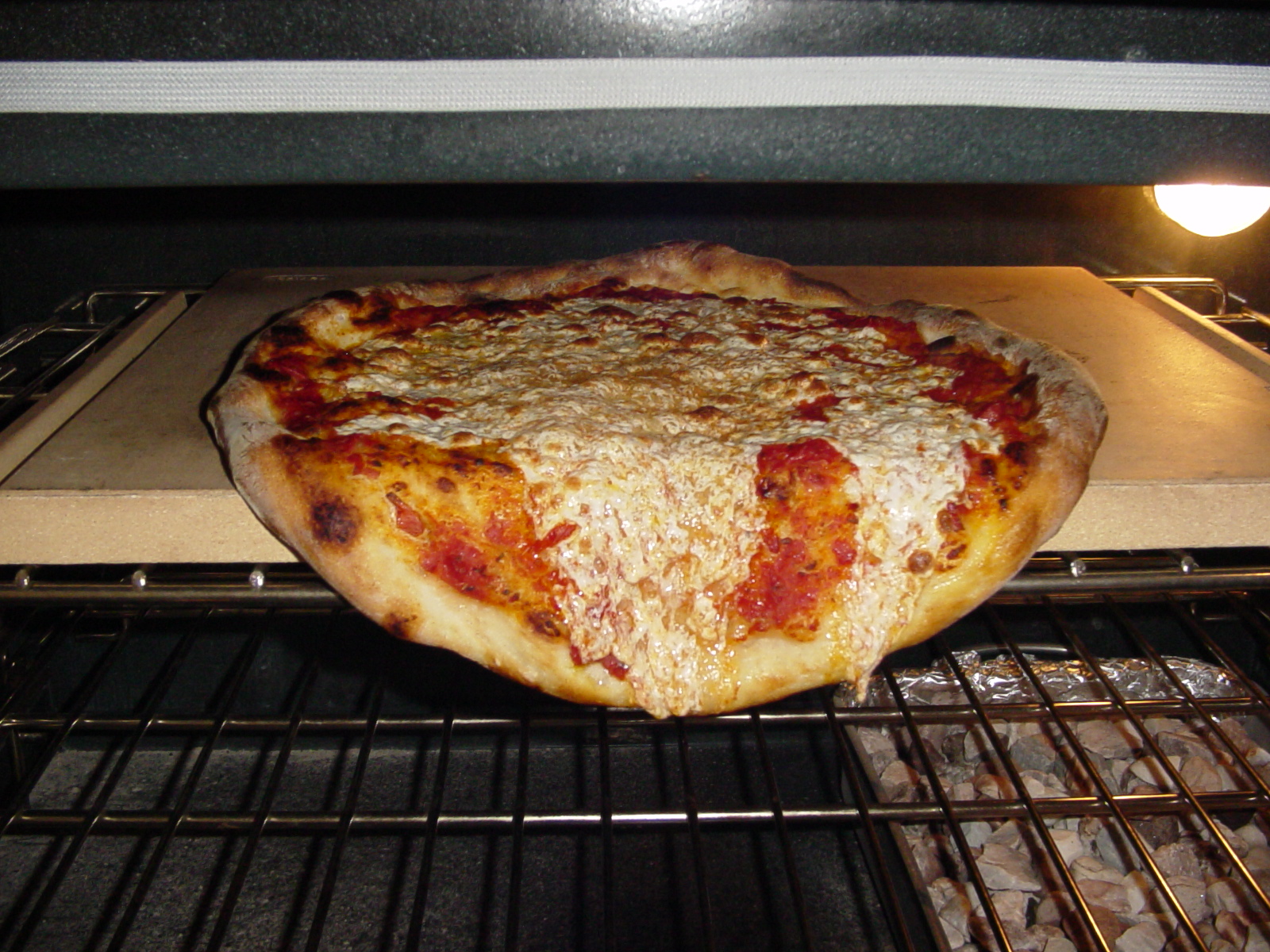
Postscript – For those of you who plan on trying the method described above for heating your baking stone, I suggest extra care in loading the pizza into the oven. With a standard peel, it proved to be difficult. The result, what I call “The Persistence of Pizza” in homage to the great surrealist painter Salvador Dali, can be seen below:


Wow, you work that dough like a pro! I’m interested in your method for getting your stone good and hot — I’ll try it, thanks!
Your super peel is exactly what I saw on a commercial level at the Bakery in Paris. The baguettes are loaded onto a couche cloth that is on a sort of conveyor belt that gets pushed in to the oven and then whipped out, leaving the baguettes inside. I’d never seen that before.
Your pizza looks yummy. I like my crust to be a little bit soft and bready as well, yet crispy on the edge a bit. Since I got my stone, my pizza is a million times better. I never use mozzarella. I have horrid memories of plastic tasting blocks from my child hood and I also hated pizza. But I should try some fresh maybe. I like four cheese pizza (blue, goat, gruyère and brebis).
Jane
Susan, having a well-behaved dough goes a long way towards making anyone look like a pro! Good luck with the broiler technique.
Jane, I’m sorry to hear about your past bad experiences with mozzarella. If you can get a hold of some good quality, fresh mozzarella di bufala, I’m sure your aversion to the cheese will be a thing of the past. I’m eager to try your cheese mixture on my next pizza. I particularly like blue cheeses, especially Roquefort and Stilton, and look forward to adding either one to the mix.
Broiler (ok we call it a grill here in the UK) – yes! This is exactly what I do. It’s taken me a while to get the timing right and positioning of the stone. The great thing is, I can leave the grill on after baking the pizza to clean the stone
The only thing I’d add is that if you want ‘authentic’ scorching on the dough – try one of the stronger italian 00 flours (caputo is the classic but there are numerous alternatives). I was sceptical at first about using ‘authentic’ flour but it really does make a difference to the crust both aesthetically and texturally.
Nice work,
FP
Oh and instead of a superpeel, I use a lowly baking sheet…it seems to do the trick
FP, as you point out, Italian tipo 00 flour and baking temperatures in excess of 700°F are required for baking a true Neapolitan pizza. What I was going for here was the chewy crust of the New York-style pizza of my youth, but an authentic Neapolitan pizza is definitely on my “to do ” list!
Your pizza looks and sounds yummy, but it ain’t no New York style pizza. Unless it’s a very greasy slice served on wax paper, with thin crust that folds back on itself and drips the tomato sauce and cheese on your shirt when you pick it up, it’s an impostor!
Harris, I see you remember the good ol’ days of having a slice or two at the Avenue L pizzeria in Brooklyn right after taking in a double feature at the Canarsie theater (for those of you reading, Harris is my older brother). Though I think the part about dripping sauce and cheese was unique to your shirt!
Nice site. Any idea what temperature the stone is heating up to with your broiler method?
Thanks
Sam, without an IR thermometer I really don’t have a good method of measuring the stone’s temperature. What I can say is that by turning the broiler on 5 minutes before pizza loading and turning it off right before loading, I’m able to heat the stone hot enough to get a 6 minute bake time.
Hello SteveB.
I just discovered your fantastic site and my overall sentiment can be best expressed by borrowing a phrase from Anthony Bourdain: you are “doing god’s work”. I do have a couple of questions.
1.) What type of equipment do you use? In your brioche post you suggested to not make the brioche unless we want to purchase a new mixer. Does that include something like a Kitchen Aid Professional or Hobart?
2.) I noticed that in addition to your pizza stone (unglazed tile?) you have what appear to be coals. Can you confirm this?
Thank you.
-jbl
Hi JBL,
Thanks for the compliment! Anthony Bourdain is one of the few chefs whose TV program and books I watch and read. Regarding your questions:
1) The brioche formula is the only one where I now use a mixer. This is only because the tightness of the dough before butter incorporation makes it necessary. All other breads, including those that are made from high hydration doughs, I now mix by hand. I’ve found that hand mixing allows one to incorporate air into the dough to an extent that no home mixer can match. For the brioche recipe, I would recommend a direct gear-driven, high-torque mixer. A Hobart or an SP5 tabletop spiral mixer should be suitable.
2) On the floor of my oven I have a roasting pan full of clean landscaping stones. This serves to increase the thermal mass of the oven, thereby moderating the temperature swings when the oven door is opened and closed.
SteveB,
Thanks for the Info here on your site, if you can find some “time” checkout this Pizza web site :
‘http://www.varasanos.com/PizzaRecipe.htm’
Joe, thanks for the web site. I’ll bet there are very few pizza aficionados who are not familiar with Jeff’s work.
My husband cut me a 1/4″ steel plate that I bake my pizza’s on. I preheat the steel plate, in my electric oven, to 450. Instead of a wooden peel, I have a similar sized flat (no edged) cookie sheet that I sprinkle with corn meal and slide the pizza directly onto the hot steel plate (It works much better for me than a wooden peel for some reason). I bake the pizza for 8 minutes, then switch the heat from bake to broil and broil the pizza for 2 minutes. This gives the cheese just a little bit of color and crisps up the pepperoni just a little. This system works very well for me and gives me a nice looking pizza. Now if I could just find a thin crust dough that consistently gives me big air pockets in the outer edge crust, I’d be a happy baker.
The pizza peel rig is genius! What material is that?
Hey Coleen, regarding that thin crust with big air, take a look at the ciabatta pizza recipe on ‘http://www.thefreshloaf.com/node/3621/quick-rustic-ciabatta-pizza-recipe-full-howto-pics’. I use this dough for my pizza which I cook on my BBQ grill (on a pizza pan). It makes a great thin crust with puffy bubbles around the edge. If you want more details, feel free to email me at myself888@yahoo.com.
JBL, the peel I’m using is a SuperPeel. Just click on the word “SuperPeel” in the body of the post to take you to the SuperPeel website.
Your pizza looks great, and i really want to give it a try. Could you tell me how to make the Sourdough Starter (50% hydration)? I am new to the dough-making world. Thanks for sharing your recipe.
Ali, the instructions for creating a sourdough starter can be found here.
Steve
For the authentic NY style “folds on itself, drips oil down your sleeve” experience give the dough a coating of olive oil before you apply your tomato sauce (using the same technique as with the sauce)
I started making pizza a couple of months ago and until I remembered the pizza guy back in the old neighborhood using the olive oil, from a can with a spout right before the sauce, I couldnt get it quite right, then with the olive oil….viola!…NY pizza, folding crust, red sleeves and all.
: )
http://www.superpeel.com/story.html
Steve
My experience was the same as the one in the Super Peel story.
Heres the trick
Sprinkle some rough ground corn meal (granular vs powder) on the peel before laying the dough on it, if some time has passed while you worked with the sauce or what have you, very lightly dust the top of the dough with flour and fold back half way and recheck adding corn meal as neccesary then fold back and do the same with the opposite side, then add your toppings and slide onto your pizza stone which you should accomplish with no problems.
The key is if any time has passed the dough will sometimes absorb the corn meal and then a wet spot on the dough can cause it to stick to the peel, always make sure to make that last check before applying the toppings, also make sure to do the very light dusting of flour before folding the dough back to check the cornmeal (just a tiny poof of dusting) because the dough can sometimes stick to itself if you forget.
[...] CETERA (scroll down on linked pages to see the video) :: New York Style Pizza :: Scoring and [...]
If your bread is as good as your website, or tastes as good as it looks, you must be quite proud. Keep up the great work!!!
I have moved from pizza to bread and am struggling with proper shaping of 70% hydration breads. I am using King Arthur Bread Flour, 80% and Italian 00 19%, with a small amount of Organic Rye 1%. I use a poolish with Ischia Island starter ~30%. I have changed the formula % and flours. I am looking for a lighter crumb with a crisp chewy crust. I am trying to dupe artisan Italian, but need a 3-4 day shelf life. Any thoughts?
Bob, thanks for the kind words.
If you are looking to produce a bread with an open crumb and an extended shelf life, then you are on the right track. High hydration doughs tend to favor the production of bread with a wide open crumb structure. Of course, the gentleness with which the baker handles the dough plays an important role as well. Additionally, what constitutes ‘high hydration’ will be dependent upon the water absorption characteristics of the flour or flour blend you are using (KA Bread Flour will absorb relatively greater amounts of water because of its higher protein content while some of the Italian tipo 00 flours that I’m familiar with, such as Caputo pizza flour, will absorb relatively lesser amounts of water). Your final dough should be fairly fluid, almost ‘pourable’. To get the proper gluten development with a highly hydrated dough, you may want to consider using the double hydration technique described here. Highly hydrated doughs are not so much ‘shaped’ as they are ‘coaxed’ into a loaf.
For an extended shelf life, you are wise to be using a natural starter. The organic acids produced by the starter serve to not only strengthen the gluten but act as a natural preservative as well.
Steve,
Thanks for the prompt reply!
I will study your recommendation and try again shaping or “coaxing” the dough. I will also read about double hydration. I realized after I sent the first comment that I was in the “pizza” section. I will make future replies in a more appropriate section i.e. Bâtard shaping.
Thanks again!
BobL
Pizza con 80% di acqua con fermenrazione di 90 ore, pure in Quovadis in facebook.
How beautiful is that pizza dough? Gorgeous! I love the crust you’ve achieved. Thanks for the recipe, and the video is great.