Pain au Levain (Sourdough Bread)
Aug 2nd, 2008 by SteveB
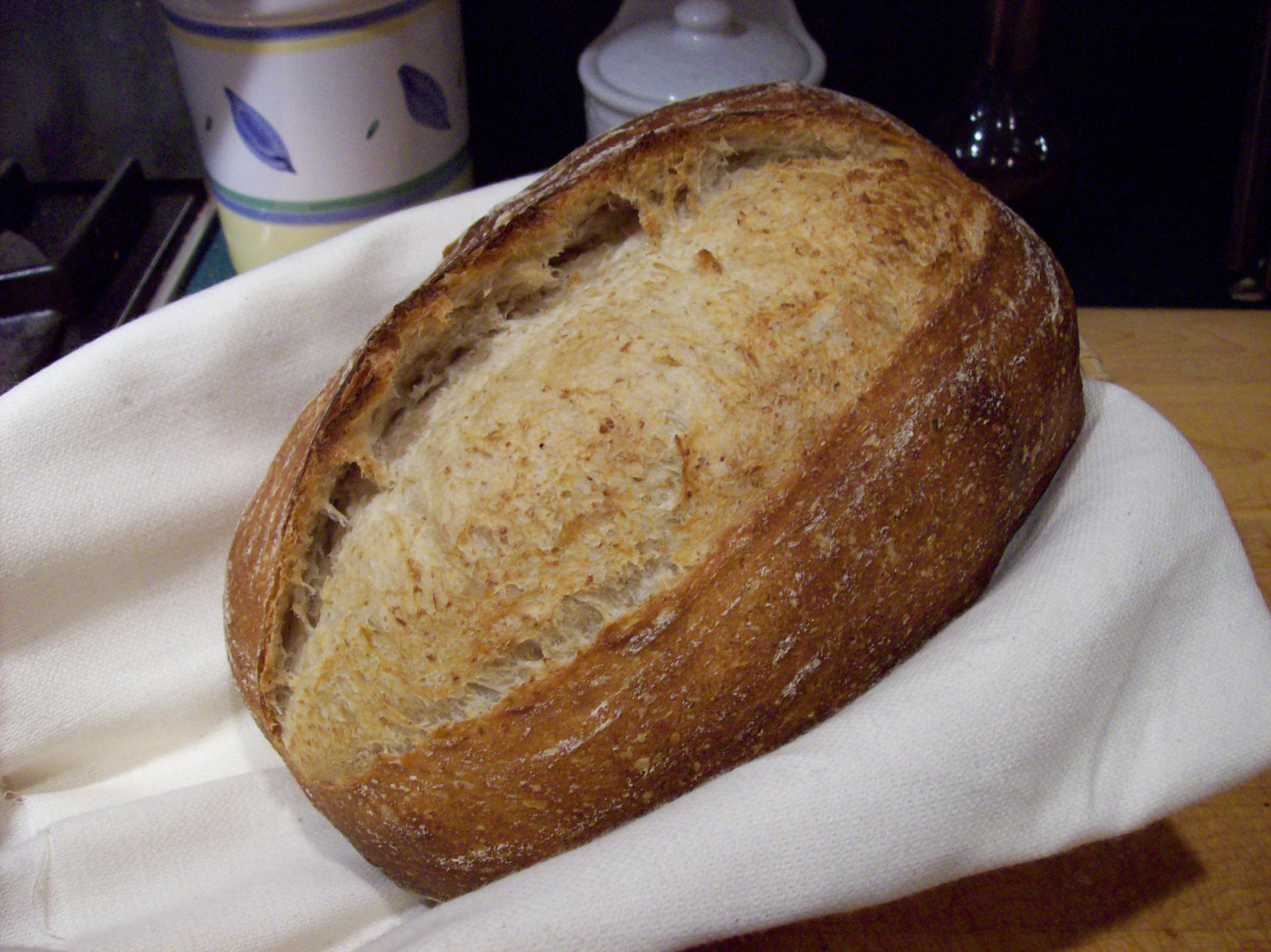
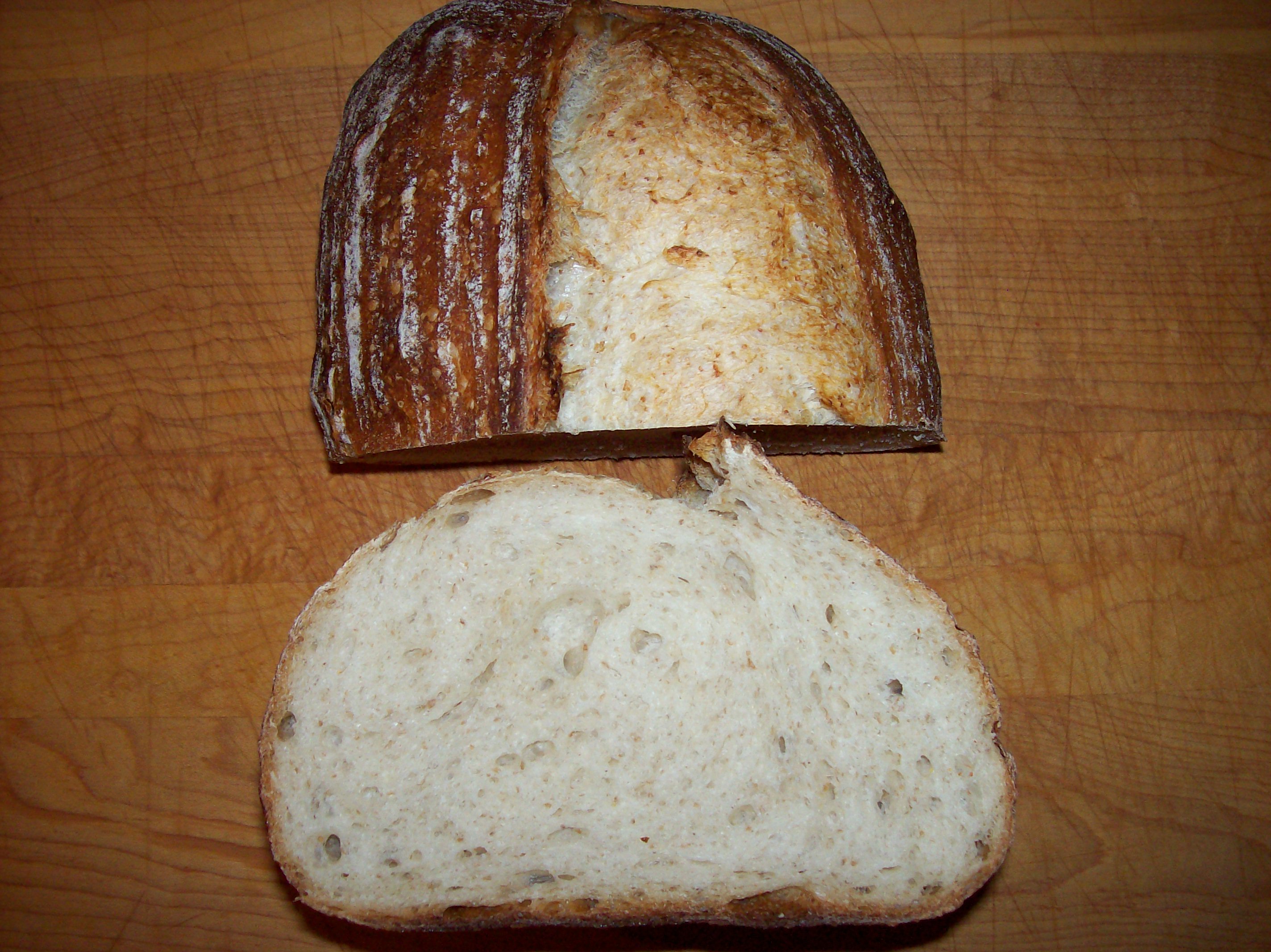
When it comes to pain au levain, I have to admit that I am a bit of a snob. Why else would I call it pain au levain rather than sourdough bread, as most people do? I’ve never much cared for the name “sourdough”. Once something carries that moniker, all sorts of lip-puckering, eye-watering attributes are expected. Instead, I believe that a good pain au levain should have a complex, subtley sweet and nutty flavor. Yes, there are acidic notes present but, in my opinion, they should only serve in background to help enhance the natural flavor of the grain.
The pain au levain formula shown here is a slightly modified version of the Vermont Sourdough formula described in Bread: A Baker’s Book of Techniques and Recipes by Jeffrey Hamelman. The modifications are due to differences in starter culture hydration (mine is 100% hydration, Hamelman’s is 125%) and ambient temperature.
Final Dough
- 680 g King Arthur All-Purpose Flour
- 90 g Medium Rye Flour
- 455 g Water
- 15 g Salt
- 300 g Levain (mature sourdough culture, 100% hydration)
Add all the final dough ingredients, except the salt, to a mixing bowl. Mix with a dough whisk just until all the ingredients are incorporated. Cover the bowl with plastic wrap and let sit for an autolysis period of 30 minutes. Remove the contents of the bowl to a work surface and mix by hand (Musings on Mixing…) for a few minutes, just until the dough starts to come together. Sprinkle the salt on the dough and continue hand mixing until the dough reaches medium development. Place the dough in a lightly oiled container, cover and let ferment for two hours, folding the dough once, one hour into this first fermentation.
After the two hour first fermentation, the dough is divided into two, 1 1/2 lb. pieces and each piece is lightly rounded. After resting under a plastic sheet for 15 minutes, the pieces are shaped into boulots, placed in rice flour-coated brotformen, covered with Saran Quick Covers and allowed a second fermentation of 2 1/2 hours.
After the second fermentation, the boulot is inverted onto a peel, scored, loaded into the oven and then baked at 425°F for 40 minutes with steam applied for the first 15 minutes (scoring and steaming video can be found here).
Hi Margaret,
If your boule is deflating when it is being transferred onto the peel, chances are your loaf has been over-proofed. Proofing can be judged to be complete when an indentation formed by gently poking the proofing loaf with a finger springs back in around 3-4 seconds. If it takes less time, it is under-proofed; longer than 3-4 seconds and the loaf is over-proofed.
I’m making my first sourdough bread. If I add more starter than the recipe requires, will the dough rise more?
Hi Betty,
Using more starter than a recipe specifies may require changes to the procedure, such as changes in mix and/or fermentation times, that can be problematic for a novice sourdough bread baker to identify. My suggestion would be for you to first attempt the recipe as written. Once you are able to consistently bake high quality loaves with the given recipe, then you may want to experiment with some of the process parameters.
After an obsessive few weeks I finally baked a loaf that made me happy. Tips I read included:
Wetter the better
Knead (or mix ) it enough
Slow rise (retard in the frig when it’s 85 degrees!)
Steam via cover
Hi Steve,
first of thanks for taking the time for putting this website together it has been very inspiring and educational for me. I stumbled across it when looking for sites on bread making and got hooked on the Pain au Levain recipe. I kept reading and decided that it wanted to start from scratch with my own starter. I successfully got one going using your very detailed instructions in the “Starting a starter article” it was awesome! Now to my problem though. I gave the pain au levain recipe a third try today and as with the first and second try the dough got way too moist with the amount of water that the recipe states. It’s so moist that it doesn’t keep any shape and is more like a thick molasses piece than a bread dough. I always have to add a lot more flour to make hold its shape which of course throws off the salt and yeast proportion. I’m using King Arthur’s unbleached flour and organic rye flour from whole foods. I’m living near San Jose, CA and my room temperature is usually around 76 – 80F with no AC turned. As is typical for this part of California the air is very dry I believe. Do you have any tips? Should I reduce the amount of water I use? If so by how much?
Thanks in advance for your help!
-Bernhard
Hi Bernhard,
Different brands and types of flour have different water absorption characteristics. It is for this reason that the amount of water added during the mix should be adjusted to yield a dough of appropriate consistency. Typically, 3-5% of the water specified by the recipe is withheld during the initial mixing. If after ingredient incorporation the dough is judged to be too dry, the remainder of the water is added. If the dough is too wet after the initial incorporation, the amount of water should be adjusted downward for the next bake.
Thanks Steve, I’ll be sure to try that out soon!
Hello Steve and thanks for the inspiration.
I noticed that in your recipe you bake at 425 while Hamelman suggests 460. When you get a chance I’d love your thoughts.
Hi Axel,
Because every oven has its own unique operating characteristics (e.g. thermal mass, hot spots, etc.), it is up to the baker to learn how his or her oven behaves and to respond accordingly. I’ve found that the temperatures specified in the posts on this blog work best for the conventional home oven I am using. Others may not. I suspect that Hamelman might be specifying temperatures that work best for the type of oven (deck oven) he is using.
Thanks Steve. This is quite a revelation for me. Perhaps it’s because of the backyard pizza oven craze (in the 90’s?) but I’ve been operating under the assumption that my (quite adequate) home oven could not get hot enough to bake hearth breads. I’ve baked a fair number of loaves where the crust is bit too dark on the bottom while the crumb remains slightly unfinished.
Steve, just found your blog (and subscribed!) while searching for clues on Hamelmans Vermont SD recipe because I just do NOT understand the 2-stage levain build he describes on pg 147 of that book. Since you did it: can you tell me if you REALY go thru that 2-stages? Can I (as hoped) just pull my active wet SD starter I use weekly and use 300gr of it? Or did you do the math for your final weight, divide by 2 (for the 2 stage levain build) divide by 225 (or 200 depending on your hydration) and do it over 2 days to build to that 300gr? If you did, could you explain it a bit? Thanks!
Hi Dino,
For the formula above, you can just use 300 g of your starter as long as your starter is fully active and at maturity when you use it. If you store your starter in the refrigerator, I would go through at least two refreshment cycles before using it.
Hi Steve,
I’m so glad to have this recipe again after a HDD problem. [I only found it through using search terms “pain au levain ‘snob’ recipe” on Google. Heheheh!]
My most successful PAL’s, of true, professional quality, after a half-dozen ‘technical’ failures were based on your highly-esteemed formula, for which I offer my sincere thanks. Your mods to JH’s original formula suit my starter hydration and environment situation perfectly. I can’t say ‘thanks’ enough times!
Adam
Hi Adam,
I’m glad you were able to locate the pain au levain formula and that it is working well for you. I checked and was gratified to learn that Google didn’t require ‘snob’ as a search term to find the formula!
[…] from the website Bread Cetera, the following adjustments were made to the original […]
I have my first attempt at this formula in the oven as I type this! Just took the steam pan out. I have to say, I am wondering how you get your breads to open so wide from the scoring. Perhaps I am not being aggressive enough with the depth of my cuts? The house smells good right now, and I’m hoping for a decent result. Either way I will be trying this formula a few more times to try and come close to perfection!
Hi Steve, I’m new to sourdough breads and would like to to try one this week. I’ve been using bread flour to bake my regular breads and noticed that you use AP flour. Is there a reason why you are not using a bread flour?
Hi Nadia,
The terms ‘bread flour’ or ‘all-purpose flour’ don’t really have any standardized meanings. What is one flour company’s all-purpose flour can be another company’s bread flour. Because of this, a better way to differentiate different types of flour is through their protein content (protein can also vary by ‘quality’ but that’s a whole different discussion). Unless otherwise noted (e.g., specifying high gluten flour), most of the formulae on this website work well with flour in the 11.3% – 11.7% protein range.
Hi Steve, thank you for the clarification. I will, however, bother you again, and would like to know your opinion re: adding vital wheat gluten to the AP flour to raise its protein content. Thanks
Nadia,
My preference would be to use flour that already has the desired protein content. That being said, if you’re having difficulty finding flour of suitable protein content where you live (here in the U.S., that should not be a problem), then adding the appropriate amount of vital wheat gluten to your flour can be an option.
Hi, with an impending blizzard, I am trying your levain recipe and I do not have rye, but substituting semolina. I am looking forward to this.
[…] about to return, so is Smittybread’s sourdough baking schedule. Last night I baked some pain au levain in anticipation of a photo shoot for an upcoming publication. And on Monday, after months of […]