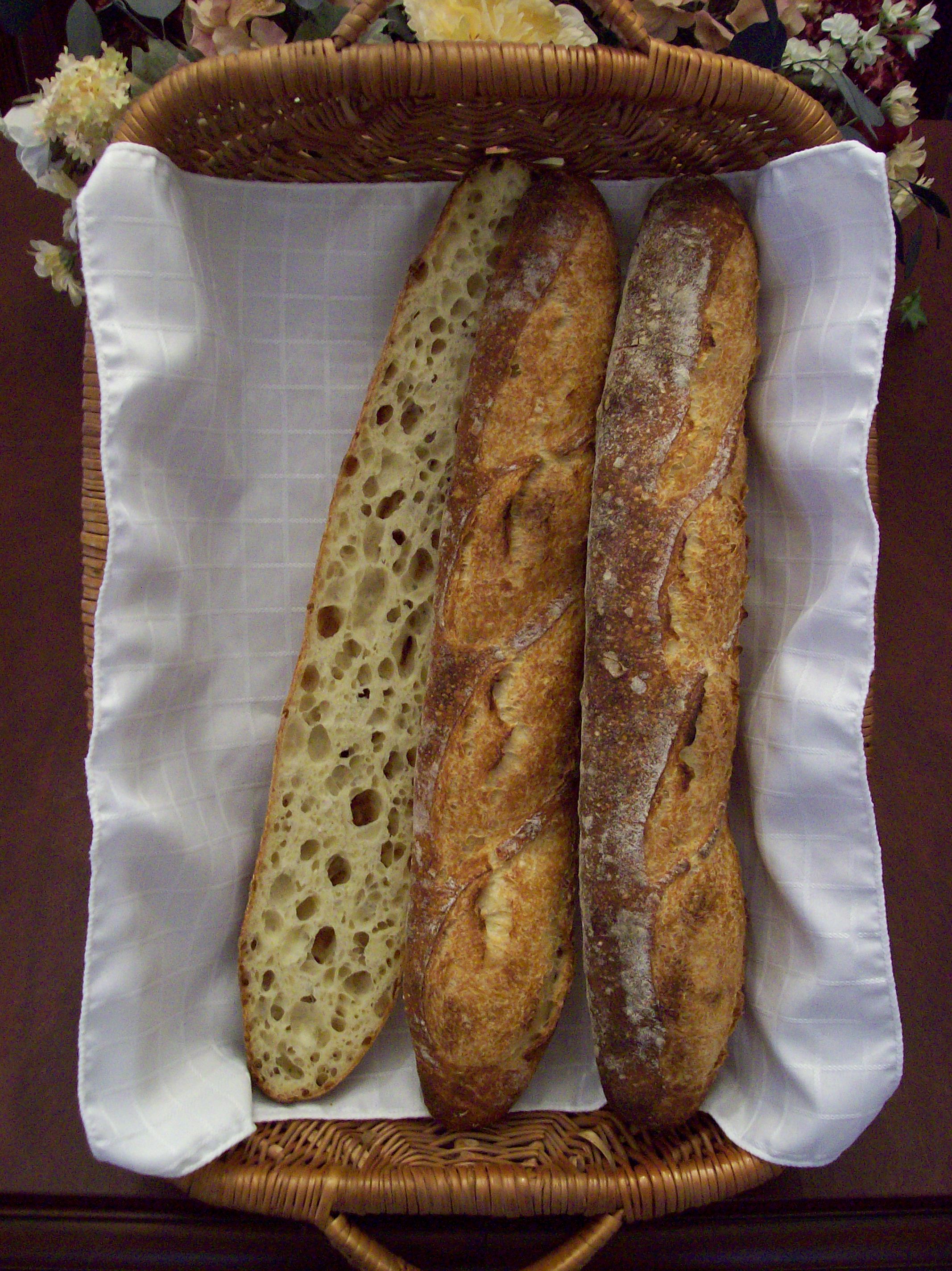
Baguettes à la Bouabsa
Nov 1st, 2010 by SteveB
When I first started learning how to bake bread a few years ago, my goal then, as it is to this day, was to be able to bake breads with superior flavor, texture and aesthetics. Most of the bread books I’d read at the time, as well as most of the professional bakers with whom I’d spoken, had emphasized the use of a preferment, whether it be a pâte fermentée, poolish or levain, to bring out the maximum flavor of the bread. Somewhere lost in the conversation was the fact that the use of preferments evolved as more of a time-saving and scheduling convenience for commercial bread production (see comment by Judson below) and that their use was not, in fact, a necessity for the production of a full-flavored bread. The use of direct dough methods, containing a long, slow fermentation step, could also produce incredibly flavorful breads.
I was recently having this very discussion with Helen, author of the food blog Beyond Salmon, who was well aware of the virtues of extended fermentation and was in the process of investigating its use in the baking of ciabatta. As part of her investigation into the extended fermentation of hand mixed, high hydration doughs, I suggested to Helen that perhaps she might want to have a look at the method used by Anis Bouabsa to create baguettes that won La Meilleure Baguette de Paris (The Best Baguette in Paris) for 2008. The original method was first described by good friend and bread baker extraordinaire Jane, author of the blog … Au Levain!, and makes use of a first fermentation time of 22 total hours! The method below was modified to incorporate an autolyse and a double hydration step in order to more efficiently develop the gluten during hand mixing of the 75% hydration dough.
Final Dough
- 500 g La Meunerie Milanaise Organic All-Purpose Flour
- 375 g Water
- 10 g Salt
- ¼ tsp. Instant Yeast
The flour, salt and yeast are all mixed together in a large bowl. A central well is then formed in the flour mixture and 325 g of the water is added to the well. The water is gently stirred with one hand, gradually drawing in all of the flour mixture until a rough dough is formed. The bowl is then covered with plastic wrap and the dough is allowed to rest for an autolyse period of 30 minutes.
After the autolyse, the dough is tipped onto a work surface and hand-mixed using the slap-and-fold technique (see Musings on Mixing…). Approximately 200 slap-and-folds were required to reach a moderate level of gluten development (further development will occur during subsequent folding and extended fermentation). The dough is then placed back into its bowl and the remaining 50 g of water is added. The water is then incorporated into the dough by further hand mixing, this time through the stretch-and-fold technique, as demonstrated here for pain au levain dough. At the beginning of the mixing, the dough will be very wet and slosh around the bowl, but the mixing is continued until all the water is incorporated. The bowl is then once again covered with plastic wrap and the dough is allowed to undergo a 1 hour fermentation at ambient temperature, with 6-8 stretch-and-folds being performed every 20 minutes during the 1 hour period. After the one hour ambient temperature fermentation, the dough is placed in the refrigerator and allowed to ferment for an additional 21 hours at 40ºF.
After the 21 hour fermentation period, the dough is removed from the refrigerator and allowed to warm to ambient temperature for 1 hour. The dough is then divided into two pieces of equal weight and each piece is pre-shaped into a short cylinder. The dough pieces are then covered with a plastic sheet and allowed to rest for 15 minutes. Each piece is then shaped into a baguette using the shaping technique shown here, laid onto a floured couche and allowed to proof at 78ºF for 45 minutes. The baguettes were then scored and baked in a 480ºF oven for 20 minutes, the first 10 minutes of which were under steam.


I missed your posts!
Glad to see you back, and baking the QUEEN of all breads!
Awesome!
Yes, please! That looks delightful. I am wondering about the flour though. Have you ever used an American national brand of AP in place of La Meunerie Milanaise, and if so, how did the results compare? Or if you haven’t, with your experience with the La Meunerie Milanaise, what obstacles might one expect by using KA or White Lily, for instance? Thanks, and good to see you back!
Chris
Hi Steve,
Thank you so much for this wonderfully detailed write up. A few questions:
1) have you noticed any difference between autolysing (is that a verb?) the dough with salt vs without salt. Do you find that autolyse improves the quality of the dough or is that just a way to achieve the same results with slightly less kneading work?
2) where do you get La Meunerie Milanaise flour? If I don’t have it yet, is there some mix of KA all purpose and bread flours that would approximate it?
3) what volume are you looking for in the end of the fermentation period? my kitchen is very cold now (about 65F), so I am not sure if 1 hour would do it.
Cheers,
-Helen
Lovely looking baguettes Steve! Can you describe the taste for us?
Syd
The baguettes really look fantastic. I never managed to get that texture with baguette recepies, and I have tried for several years. However, when I skipped the poolish and went along with the biga with some rye instead I got a marvelous result. My friends say that this bread is the best they ever tasted and that the ones you buy in the bakery is less tasty and less chrunchy.
The funny thing is that I got these excellent result when using the flour I bought in Thailand, but repeatedly failed with flour I normally bought in Sweden.
Thank you all for the compliments. They are greatly appreciated.
1) Sally – Dare I ask what the KING of all breads would be?
2) Chris – This is the first time I’ve tried baking Bouabsa-style baguettes, so I can’t really say how the La Meunerie Milanaise flour behaves differently from standard American AP flour in this formula. There was no special reason for me using the La Meunerie Milanaise flour except that I enjoy playing around with different flours. It’s protein content isn’t that much different than, say, King Arthur AP flour (the La Meunerie Milanaise flour might be a bit lower), so I wouldn’t expect there to be too much of a difference in performance.
3) Helen – I hope the post gives you some good ideas for working with high hydration doughs and extended fermentation times.
1 – As you suggest, a true autolyse step is performed before any salt is added. This is because the hygroscopic nature of salt supposedly inhibits the thorough hydration of the flour. I didn’t find that to be an issue in this case. Autolyse was developed to allow for a shortened mixing time. It does not materially improve the quality of the dough produced, unless the dough is mixed in large mechanical mixers and an extended mixing time would overoxidize the dough.
2 – I was able to purchase the La Meunerie Milanaise flour from a small bakery in Plymouth, MA. King Arthur AP flour should work just as well in this formula. I would not use King Arthur bread flour here as it has too high of a protein content for this bread.
3- I never judge the progress of a dough’s first fermentation by volume but instead by how the dough ‘feels’. This is one of those areas that is difficult for me to explain but I’m sure you’ll get the feel of it with practice. The dough for this formula will hardly show any increase in volume throughout the entire 22 hour fermentation process. The volume of the loaf comes almost entirely from its oven spring.
4) Syd – Flavor is another thing that, for me, is difficult to accurately describe in words. While having all the wheaty and nutty notes of baguettes made with preferments, the Bouabsa baguettes also have a sweetness that is not as evident in conventionally prepared baguettes.
5) Staffan – Perhaps the flour you bought in Sweden didn’t have a sufficiently high protein content. Flour with a protein content of anywhere from 11-12% should work fine with this formula. Your success with a biga, which typically produces a stronger dough than a poolish, would tend to bear this out.
In my humble opinion, the King of Breads is the Pain Poilane!
Steve,
I have been waiting for your next post and your timing couldn’t be better as I was planning on baking tonight …
Tom
Bravo Steve, these baguettes are stunning! Wish I could taste one!
And the answers you offer in the comment section are always very interesting.
Hope we’ll get to taste the new “best baguette in Paris” together in the near future… (http://www.leparisien.fr/laparisienne/cuisine/c-est-le-meilleur-boulanger-de-paris-23-03-2010-859248.php)!
Flo,
Thanks for your comments and the link to the Le Parisien article and video on Le Meilleur Boulanger de Paris. I, too, hope we’ll be able to get together sometime soon to sample the best baguettes Paris has to offer!
Great stuff. That crumb structure, with the even distribution of large holes, is among the best I’ve ever seen.
Wish I could have one of those right now.
So, you finally tried them! Looks like perfection to me.Have you done the Gosselin ones? I can’t remember. You should compare them.
Hi Jane,
I did try baking the Gosselin baguettes once, much earlier on in my bread baking adventures when my skills, as well as my doughs, weren’t all that well developed. I think it might be time to revisit them.
Great baguette! I’m trying it this week-end. But first things first, I need to replenish my flour cupboard and will go this afternoon buy both La Milanaise Farine bise à pain (stone ground bread flour) and Les Moulins de Soulanges Farine à baguette, among others.
Regarding your discussion about use of KA or La Milanaise flour… From what I understand about the difference between bread flours developped in anglo-saxon parts of the country and the ones developped in recent years in Quebec (La Milanaise, Les Moulins de Soulanges, Les Moulins Bleus…) is all in the selection and cultivation of grains bearing in mind a particular final use of the flour. Traditional bread making in the west provoqued selection and breeding of crops of wheats designed for successefully bake the traditional american loaf. For that type of bread, a good flour would be high in protein content, have a great absorbtion capacity and sustain robust kneading.
European or Latin traditional baking requires a different set of qualities.
What’s happening here in Quebec is great! As a die hard home baker, I’m so happy things are changing this way (when I came here in 1994, I thought I’d fall in depression when I first bought and used flour to bake my bread!)
The trend towards old-world traditional breads resulted in the quest both by professional and home bakers for grains and flours behaving differently than the ones used in traditional american loaf of bread.
A synergy between the demand for quality old-world (french in majority) artisan breads and a taste for organic agriculture products resulted in the strong will of true artisanal bread makers and organic mills to work with farmers so they switch from the anglo-saxon type of bread (the direct method white american loaf) to the latin traditional ones (italian and french mostly), therefore occupying a niche overlooked by the industrial mills.
La Milanaise and Première Moisson recently joined forces (and talents) to cater to artisan bakers by opening a mill (Les Moulins de Soulanges) which works very much like french mills. The mill develops commercial mixes which will allow artisan bakers to make a good baguette or croissant. They prefer though, work directly with the baker to design his own mix and coordinate steps to obtain such mixes (and bread) from the local (as in “grown in Quebec, on Quebec’s soil, in Quebec’s type of climate”) field to the artisan shelf. It’s interesting to note that this type of work lends itself to “Terroir” notion. (sorry, I can’t find a suitabe translation for the word terroir).
Therefore for us home bakers, if I understan well, the choice of grains, methods of cultivation, selection of wheats are all done bearing in mind the baker, its method of production and the type of bread he makes, then the result obtain from flour mixes from say KA flour mixes should give a different result from La Milanaise or Les Moulins de Soulanges flour mixes for a given bread.
In my kitchen, if I’m to make kaiser buns or a white american loaf, I’d use KA flour. If I was to make baguettes or croissants, I’d use Les Moulins de Soulanges baguette or croissant flours and if I was to make a miche au levain I’d use either La Milanaise or Moulin Bleu stone-ground bread flour.
Just 10 years ago, Première Moisson bakeries didn’t find a suitable flour to make a good traditional baguette. They imported the flour to be used for baguettes from France. Now with this synergy between Quebec’s growers, mills and leading artisan bakers we can find more suitable flours for our baguettes or miches.
So this afternoon, I’m going to replenish my stock of flours. 12 yesrs ago this shoping trip would have been only a utopic dream.
I’ll buy regular bread and AP from Five Roses (KA not available here) for making american sandwich loaves or buns, La Milanaise stone ground Farine bise à pain for my levain breads, Les Moulins de Soulange Croissant flour for my viennoiserie baking (croissants, pâte feuilleté, danishes…) and Les Moulins de Soulange Baguette flour.
I can’t wait to try out your adaptation of Anis Bouabsa baguette!
I realise I sound like a commercial in my comment. I feel I should tell you I’m not affiliated in any way to any of the companies I mention. I’m a home baker always trying to better myself at the art and therefore, always trying different flours from different companies. I mention what I use by company name for clarity’s sake, not for advertising.
Hi Steve, Wow another great post. You are so inspiring and I have to say that when people ask questions I can’t answer, which is often, I always come to your blog for inspiration and information. It is a truly wonderful, educational and aesthetically pleasing resource for us home bakers you have made here. The pleasure you show in your baking and the care with which you write up your work is amazing. I still haven’t made any croissants but I watched your video again today and soon….
Hi Steve Joanna kindly pointed me in your blog direction and I’m so glad she did as I had this question about sponges. Which you sort of answered in your post. I keep coming across recipes that require you to start your ‘sponge’ mix from as little as 1-2hrs to over night ones and I didn’t really understand why such big differences in timings with different recipes. I wanted to know if the 1 or 2 hr sponges could possibly do anything for flavour in that time.
From your post I understand that you feel both long time ‘sponges’ and slow proving dough arrive at the same destination; extra flavour.
After reading this post, I should have gone to bed…but my brain started as it does to tick away at this…why? I can only grasp at the new found knowledge I have acquired recently through my research into pasta dough for one of my posts. I had to get into the small details of wheat proteins = gliadin + glutenin = long amino acids chain.
Took me a while to get my head around it but finally it stuck after reading McGee’s entry on Gluten. His explanation of proteins in the flour which are awaken when mixed with enough water to form these networks of gliadin & glutenin that are made of amino acids was a light-bulb-over-head moment for me.
So tonight on reading your ideas of ‘timing’ made me think about these little chemical reaction in the dough – what if is just about timing? these networks from gliadin & glutenin form and hold the dough in shape throughout the handling and then secure the dough structure in place through baking but what IF with enough time they are also giving off something else like aroma?
I googled glutenin and read this in Wiki: It consists of 20% HMW (High-Molecular-Weight) subunits, which are relatively low in sulfur. The other 80% are LMW (Low-Molecular-Weight) subunits and are high in sulfur. I tried to read further but my brain capacity can’t understanding beyond this.
Am I making sense here? it’s getting late now and brain frazzled but I’m thinking those gliadin & glutenin are responsible for more than just the physical appearance of the dough…the flavour…with the allowance of time. What do you think?
…sorry meant to say what fantastic looking bread you have there…my absolutely all time favourite bread shapes; baguettes. I’m a crust girl so the ratio of crust to crumb is perfect for me and these look the sort I would almost kill for
I will come back and check out your blog further.
Hi Zoubida,
Thank you for your detailed and very informative comment regarding the current state of flour production in Quebec. You did not sound like a commercial at all. Informed commentary such as yours, whether it be regarding bread baking ingredients, equipment or techniques, is always welcomed here.
I wholeheartedly agree with the notion that different types of bread often demand flours of differing characteristics. That is one of the reasons why I continue to experiment with different flours. For example, I’ve always found that doughs made with KAF AP flour tend to be a bit too strong for conventional French breads, such as baguettes. While KAF AP flour can be used for French breads in a pinch, I’ve found flours such as KAF Organic Select Artisan flour, La Meunerie Milanaise Organic AP flour and Heartland Mill AP flour to be more suited to this purpose.
Following in the footsteps of oenophiles, “painophiles” (I’m not sure there is such a word but if not, there should be!) here in the U.S. are starting to become more aware of the concept of “terroir” as it relates to wheat cultivation. From a personal perspective, the opportunity I had to bake with T55 bio flour from France really opened my eyes to the ways in which even small differences in regional factors (e.g., soil composition, climate, etc.) can have a dramatic effect on the quality of the wheat and thus on a flour’s performance.
Now, Zoubida, if there was only some way you could entice some of the Quebec mills to make their flours available here in New England!
Joanna,
The cooler autumn weather is ideal for pastry baking. I’m looking forward to seeing those croissants of yours!
Hi Azélia,
It’s always nice to hear from someone who is interested in the chemical and biological processes occurring during bread baking.
Preferment sponges that are developed over a relatively short period of time contribute more to leavening ability and less to flavor than longer fermenting preferments. A sponge can also serve to help build strength in a dough.
With the exception of the artificial sweetener aspartame (a dipeptide), peptides and proteins themselves typically exhibit little flavor (amino acids are involved in the Maillard reaction which does contribute to crust flavor). The degree of gluten development has little to do with flavor development. It is the organic acids, esters and sugars that are formed during the fermentation process that contribute to a bread’s flavor.
just to let you know how un-scientific I am Steve I had to go and look up what esters where! I failed terrible in sciences at school! If only they associated with making bread & food generally I think I would have paid attention then
you’re the first person I’ve encountered that seems to understand process not just technique.
going back to your answer, I’m guessing the ‘organic acids’ are present in the wheat?
The reason I started on this quest about ‘sponges’ was two reasons.
First last night I was making pitta bread following a recipe that suggested I make a sponge for 1-2 hrs, and I just couldn’t see with that type of bread what benefit it would gain, since you’re not developing flavour, nor wanting crust, or really wanting strength in a way I can figure out.
so it kinda leaves me thinking it’s not necessary. The first time I made them I used the sponge method and last night I didn’t and though the memory cells can play tricks on you I couldn’t see what the sponging time added, but until you do a side-by-side experiment it’s difficult to know exactly I suppose.
The other reason I started to wonder about ‘sponges’ is because of my late grandmother’s broa, I don’t know if she used wheat in it but at the moment I’m guessing she used rye flour with cornmeal, I have to no idea of knowing just guessing from a geographical area where she lived in Portugal and how dense her bread use to be.
I have come across blank in my research with a recipe for cornmeal & rye bread, most recipes have wheat with cornflour. She use to grow corn on her fields but I don’t know about the rye. I know she use to make her own linen therefore grow flax. Her bread was very yellow, very dense, quite flat & spread out and the most distinguished thing about it was it’s really really hard crust that cracked into a pattern. The crust looks like those cracked dark cookies you see that are covered in icing sugar. I have a photo of that kind of bread from a Portuguese blogger who found it for me but no recipes.
Somewhere in my my net search I have come across reference to broa made with cornmeal & rye, and stating one part rye to four parts cornmeal. I know my gran used her own leaven because my dad remembers her feeding it every week. I made my first attempt shooting in the dark expecting to fail and yes of course I did. Now my thoughts are turning to whether I should start off with a sponge, would that give me a better fighting chance of succeeding? But sponges are all new to me, so haven’t got a clue!
Azélia,
Organic acids, such as acetic acid, lactic acid and other, longer chain acids, are formed as products of yeast and bacterial metabolism during the fermentation process.
I decided to try this recipe along with your methods of shaping and the bread is some of the best I’ve made to date. The long slow fermentation added just the right amount of tang while still retaining the sweetness I like in baguettes. Thank you for taking the time to make videos with clear instructions that are easily followed.
Cheers,
Toni
Hi Steve,
I was about to let you know the results of my trial with your interpretation of Anis Bouabsa’s baguettes. But in the preceeding comment (Toni) said exactly what I think of it. Plus I have to say it is such a straightforward, low involvment recipe. It’ll be our everyday bread for now.
Thanks for sharing.
Hi SteveB, I was so inspired by your beautiful baguettes I thought I’d give it a shot. I was able to locate some La Milanaise flour, as you used. I posted about it on TFL:
http://www.thefreshloaf.com/node/20485/try-baguettes-la-bouabsa-and-steveb
Thanks for your lovely writeup and post about this bread.
Regards, breadsong
Hi Breadsong,
Thanks for posting about your experience baking baguettes à la Bouabsa. It looks like you’ve achieved that nice open crumb characteristic of these loaves. And I’ll give your first baguette a 9.5 for the double gainer (just joking… nice job)!
Hi Steve – your formula says to divide the dough into two 250 gram pieces. I didn’t catch that before I started to divide mine. My total dough weight (after I put it back on the scale) was over 800 g (forgot to write it down), so I have three baguettes, one at 250 grams and the others varying at 300+ g in the oven.
Steve
Glad I found out your blog. I am a learner in bread baking. Your tips will help me improving my bread baking skills.
Swathi
Thanks Steve…there was just no saving that poor baguette as it made its ungraceful descent!
I was quite happy to find La Milanaise flour, and like the flavor it imparted to the finished baguette. I was previously unaware of this flour mill and, as a Canadian, am happy to discover a good Canadian product!
Regards, breadsong
Hi Steve and Breadsong.
I thought you’d be interested in reading this December 2007 article from The Gazette (the english newspaper in Montreal). It seems the development of Terroir both in Ontario and Maine is in progress.
http://www.canada.com/montrealgazette/news/story.html?id=058ef216-7c72-40ee-9fa5-75f868b4583e
Zoubida, thanks for the link to that interesting article. That was very thoughtful of you! Regards, breadsong
Have just discovered your site-how inspiring!
Can you suggest a good flour to use that i can get hold of in London?
thanks so much
Hi Aliyajade,
Living in the U.S., I’m unfortunately not in a position to be able to speak authoritatively on flour in the U.K. However, this article, written by U.K. baker Dan Lepard, looks like it might contain the information you seek.
Absolutely Fantastic! I, too, just stumbled upon your site and must say, this is a blog after my own heart.
I started baking bread when I left work to stay home with my baby. I’ve had a mere year under my break-making belt but am learning much more everyday. I’ve always been considered an excellent cook. Although bread baking is much more of a science and less forgiving. You are the first person who has actually made me want to weigh my ingredients.
I was looking for a wonderful dinner roll recipe for the upcoming Thanksgiving Holiday when I happened upon your blog. I have found rolls to be the most difficult for me to master, in terms of the crumb. They always seem to turn out too dense or closed crumb. The only decent flours I have easily available to me are the King Arthur AP, Bread, and 100% Whole Wheat. From your post it looks like they will do fine even in the more artisan breads. I took a look at the cloverleaf rolls and will test drive them, so to speak, tomorrow. However, now that I am here, I find a fast growing list of future experiments. Topping this list will have to be these beautiful baguettes!
Kudos to you Steve; I look forward to poking around some more on the site.
Hi Julie,
Welcome to Bread cetera! Thank you for all your kind words.
The King Arthur flours you mention are quite suitable for the breads that are posted here. I hope you enjoy baking and eating the cloverleaf rolls and any other “future experiments’ you decide to conduct!
Steve,
Will this dough work for making an Epi Baguette?
Thanks,
Jonathan
Jonathan,
This dough is considerably more hydrated than conventional baguette dough but one should still be able to cleanly cut an epi shape.
Steve,
I’m going to bake the baguettes on Thursday for a dinner party on Friday. Usually I would bake on the same day. What would be the best way to store them for the next day?
Thanks,
Jonathan
Jonathan,
Baguettes become stale relatively quickly and should be eaten on the day they are baked. My suggestion would be to bake them on Friday morning for your dinner party later the same day. If you must store them, freezing would be an acceptable alternative.
I am very impressed with your double hydration method, Steve. I didn’t report back on my November 7 attempt for a couple of reasons. I was a bit over enthusiastic doing the Bertinet slap and fold and wound up breaking my bread board. Shaping the baguettes on a Wilsonart HD counter was challenging, to put it mildly. Baking the three baguettes (I guess I should call them ficelles, given their size) gave me some great insight into the venting of my gas oven when using the method of ice cubes in a perforated pan over lava rocks. The cuts on the ficelle in the front opened beautifully and even produced a nice grigne; the one in back was a dud. The middle one was okay. As I had a loaf of sourdough that needed to be consumed, I froze the ficelles. In view of my manhandling during the shaping, I didn’t expect much out of the crumb so when I took one out tonight and sliced half lengthwise, I was astonished to see a beautiful, open crumb. I can only attribute this to your methodology.
I have a lovely new bread board and am planning a do-over this weekend. Mixing the dough is as much fun as eating the bread. Thanks!
Lindy,
I’m glad the double hydration method worked well for you. I wish I could take credit for the technique but it has been used routinely over the years to efficiently develop the gluten in high hydration doughs.
I am relatively new to bread making, particularly baguettes. I’ve made the 5 minute a day and Rose Beranbaum’s with OK results. I am happier with yours but not happiest-yet. Particularly, what element, step or action results in big holes-type of flour, proofing time, kneading, hydration or something else. Thank you for the videos and Happy Thanksgiving.
Thanks,
Jeff
Hi Jeff,
Unfortunately, there is no single step or variable that determines the characteristics of the crumb. It is all of the factors that you mention, and more, working synergistically, that contribute to a bread’s crumb structure. By methodically experimenting with these variables, you will soon learn how to produce breads with whatever crumb structure you desire.
Hi Zoubida:
Moi aussi je suis de Montreal. I just recently plunged into this wonderful world of baking by discovering the KAF website. I am now addicted to this new obsessive hobby. I ended up ordering a big bag of KAF but I am not sure that I would want or need to continue doing this since I heard that our Canadian AP flour has high protein content (is that true?).
I noticed that there is a very large following and artisan (home and professional) community in the US (most blogs, websites, etc…I have found are mainly US) and very little resource for us Quebekers. Where do you go in order to find the other types of flour you mentioned in your postings. I am baking from Peter Reinhart’s book Artisan Bread Everyday (LOVE that book) but I’m getting only moderate results (although his crumbs and crusts are EXCELLENT and so flavorful). Any suggestion as to how I can improve my skills (other than experimenting of course) here in MTL (for example, I thought about taking a bread 101 class with l’Ecole du pain at St-Francois de Fillions) and find other kindred spirits in search for that magnificent homemade artisan bread?
SteveB…I am soooo glad that I bumped on your site…what a great blog, can’t wait to try some of your recipes. I had heard about you on TFL but couldn’t figure out what people were referring to (or of whom). Now I know!!!
Thanks for creating this exciting blog and sharing your quest to all of us.
Mado
Hi Steve,
When my youngest son was born, we discovered that he was allergic to gluten, in fact, he was allergic to all grains except rice. He did not get a belly ache like the 3 celiac children or the celliac wife, nor bleed like the celiac father-in-law, his reaction to gluten was to stop breathing. At about the same time we were learning about celiac disease and my son’s wheat and gluten allergies, my hobby of baking was kicking into high gear. I was making all of the recipes out of The Bread Bakers Apprentice, I had a lame, baking couches, linen lined rising baskets, plastic tubs with lids for pre-ferment, etc. Now, wheat flour cannot be used in the house. HOWEVER, I can mix dough and back on the back porch. I will try your techniques and document them at http://www.norcalovenworks.blogspot.com and see how your recipes do in a propane and wood fired oven.
hi Steve:
your blog is awesome!
the pocket and crumb in the baguette is amazing.
it;s my dream to bake the baguette having big alveoli and crispy crust. However I tried and tried. I still can;t figure out the problem. The crust is ok but there is no big pocket in the bread.
here is my recipe:
T55 flour
salt 2%
water 68%
active dry yeast 1.5%
1st fermatation 120 min, flip over at 60 min (ambient temperature0
devied 2 pieces
bench time 20 min
shaping and then final fermetation 30 min
baking 210 C for 27 mins
the temperature of the doung after 1st mixing is around 24.5 C
I am so frustrated….
Steve – Thank you. The recipe was a little potchedik to read, but pretty easy to follow after reading it several times. The baguettes came out perfectly, and the crumb looks pretty much like the recipe picture. I did have a question about how much flour shows on the baguettes in the picture. After flouring the (new cotton) couche and the final pre-bake rise, I rolled each baguette onto a lightly-floured wood peel. A lot of flour more flour stayed on the baguette than I had thought from the picture. I am assuming that a broken-in canvas or flax couche would take less flour, so I’ll try that. Again, thanks.
Hi Tom,
I think you’ll find that a well-seasoned linen couche will require less flour to prevent dough from sticking than a newly acquired cotton couche. You should get the hang of it after you potchke around in the kitchen for a while.
[...] Công thức và cách làm dưới đây được tham khảo ở Bread Cetera. [...]
[...] Công thức và cách làm dưới đây được tham khảo từ Bread Cetera. [...]
Happy New Year.
Crumb is more open with longer final rising time. Can the baguette recipe be adapted, a la the ciabatta recipe, to using a mixer rather than the 200 slaps?
Hi Jeff,
A Happy New Year to you as well!
There shouldn’t be any problem with using a stand mixer to mix the dough. I would suggest, though, using a version of the double flour addition technique as described here.
I’m lost. Sorry if you’ve already posted this. How do you modify the double hydration, double flour ciabatta recipe to make a machine knead baguette? Do you still do the poolish? The water/flour/yeast proportions are the same in both. What is the purpose of the olive oil? Do you still employ a 21 hour ferment?
Thanks
Jeff
Jeff,
Double flour addition and double hydration are two separate techniques. I am suggesting that you use the double flour addition technique. This involves first incorporating a small amount of the flour with the water using the mixer’s whisk attachment to aerate the mixture. The remaining flour and other ingredients are then added and the dough hook is used to fully incorporate all the ingredients. The remainder of the procedure is then followed as written, starting at the 1 hour fermentation at ambient temperature. No olive oil is used in the making of a baguette.
I gave this a whirl, and the results were great. I struggled with the 200 slaps – my dough was very stiff and I had to labour through this. THe dough did relax a little, but was sticky and not as stretchy as the video indicated it could be… (why???) It didn’t seem to matter in the end though. I have never had the pleasure of tasting an authentic French baguette before, but my result from this recipe was tasty. Nice crisp crust and visually very similar to the photo in this blog. Is the bread intended to be chewy? The texture of my loaves reminded me very much of ciabatta – just a different shape? Is that the intent?
Hi Gareth,
The crumb of a ciabatta should be a bit more tender than a baguette due to the presence of olive oil in the dough. If your dough was very stiff, you may want to try adding a bit more water to the dough the next time you mix up a batch.
This bread looks so good .I’ve had good results with several different breads and pizza doughs using an overnite preferment and have been wanting to try “overniting”a whole batch.I started this yesterday early afternoon.I did use our Bosch U+ rather than hand kneading but weighed all the ingredients and followed all the steps…..and ended up with a wet, soggy, sticky unshapeable mess.I’m waiting for it’s final rise now but I’m not optimistic. I did use regular APflour,is there that much difference? One reason I tried this recipe is because I thought AP flour would be rather generic? I’ve had everything else turn out great since we got our Bosch and this is kind of discouraging,is this just a very advanced recipe? or did my generic AP flour just absorbe that much less water? I’m not complaining(LOL) just very curious,Thanks!!!
Hi Don,
The phrase ‘All-Purpose’ when used to describe flour provides little, if any, real information about the characteristics of the flour. All-purpose flours can vary widely in specifications and performance from brand to brand. Because of the wide variability of flours, when one is attempting to duplicate a bread formula I always suggest adjusting the amount of water added during dough make-up, as needed, so that the dough obtained has the same firmness and degree of development as that described.
Hi Steve,
Thanks for your reply info and especially for the great,informative site!!
I did get some oven spring from my attempt and they had an excellent flavor,just very dense and an obviously different texture from your pics.I have been adjusting the water/flour in my bread doughs but this was my first attempt at a high hydration recipe and I wasn’t quite sure what to expect.
I am a novice at bread and should’ve known my”spartan”store brand AP was going to be very different from a really good brand.Next time I’m in Gordons Food service,I’ll see what flours they have,I’m just too stingy to pay the price for 5lb.King Arthur flour in our grocery store. We’re living on my wifes income and a very tight budget while I’m building our dream home LOL
Steve
With all this effort I’d like to double the recipe. Do I double the ingredients or are there some modifications. Any technique changes?
Thanks,
Jeff
Jeff,
As long as you are weighing your ingredients, you should have no problem doubling the recipe simply by doubling the ingredient weights. No changes in technique should be required.
BEAUTIFUL BAGUETTES!!! I wish I could get an open and airy crumb like that!
Do you mind sharing you secret? lol
Hi Colby,
Thanks for the compliments. But there really is no secret… it’s all laid out in the post above.
Just finshed baking a batch and I have to say it is the best looking bread I have ever made. The oven spring doubled the height and the crumb is incredible. Last weekend I made the ‘Pan al’ Ancienne’ from the Breadmaker’s Apprentice and I have to say that that loaf didn’t have the crumb but it had a much chewier texture and better flavor. The differences are that for the Pain al’ Ancienne I used: (1) KA bread flour and for the Bouabsa I used KA all-purpose flour; (2) the hydration for the Ancinne was slightly higher (80%) than the Bouabsa (75%); and (3) the Ancienne was mixed using a spiral bread hood while the Bouabsa was mixed by hand according to the directions.
Any thoughts on using the KA bread flour for the Bouabsa? I think using the bread flour gave my Ancienne a better flavor than the Bouabsa.
David,
The main difference between KA AP flour and KA bread flour is that the bread flour has a higher protein content. Since protein contributes fairly little to the flavor of a bread (the major flavor components being organic acids, esters and sugars), I would think that the different flour types had little to do with the differences in flavor you experienced.
Steve,
Another wonderful post; the open crumb structure and crust color of these baguettes is beautiful and I don’t doubt their flavor. I ate a baguette some months ago made using a similar technique and was amazed at the sweetness. I disagree with the notion that yeasted preferments were developed as a short cut around long fermentation in straight doughs. Far enough back, all leavened bread was made using a sourdough process and when beer yeast was first made available to bread bakers it was used in a way that both emulated the levain sponges of the time and maximized the leavening potential of the very poor quality (by todays standards) beer yeast; giving birth to what we now think of as preferments; and which many of use in our doughs in conjunction with additional commercial yeast. An interesting baguette experiment would be to leaven a dough only with the pre-ferment, say, poolish, and also allow for a long bulk fermentation time.
I think what is happening in Quebec and Maine in grain production is very exciting! Here at the King Arthur Flour bakery we’ve been working on formulas that incorporate more wheat grown here in Vermont. We also used high extraction flour from Milanaise for a time in our Miche – wonderful stuff.
Bravo on the baguette and to another wonderful post!
Hi Judson,
Your point is well taken. From an historical perspective you are quite right; the straight dough method was developed some time after methods that used yeasted preferments.
In an attempt to describe how contemporary commercial bread bakers use preferments as a means of making their processes for the production of full-flavored breads more efficient, I inartfully used the word ‘evolved’ and perhaps attributed an historical subtext that was not warranted.
Thanks for keeping me honest!
Well you’ve kept me quite honest and upped my home baking skills significantly! I sometimes can’t help but add my two cents… I love your blog and recommend it to people as the best home baking resource the internet has to offer
hi STEVE,
i am new here and i was watching your website, just one word…. …..PHENOMENAL….i believe you are GOD of BREAD…
Hi Rahim,
While I appreciate the overly generous sentiment, since the quality of a bread is a function of the skill of the baker who bakes it, your recent successful foray into baguette baking only serves to confirm that there is a little bit of ‘bread god’ in all of us!
Hi! I just saw the scoring and steaming video, and am wondering what the blue ‘gun’ you use for steaming is..? I recognize the deep hotel pan you invert over the bread, but the gun is too cool. Thanks.
Hi Patrick,
The steamer I use is a SteamFast SF-227 hand-held steamer, although any similar hand-held steamer with a pointed nozzle should work just fine.
Hi Steve, Just wanted to let you know how thrilled I am to have discovered your site. I was searching for a Pain De Campagne recipe and that’s how I came upon your site. I’m so looking forward to searching through your previous recipes. This weekend, I will make the Pain De Campagne, the first of many recipes I will try.
Hi Julie,
I’m glad you’re enjoying the site. Have fun baking your way through it!
Thanks for your recipe, maybe you rememeber , I dont speak english, but I can read more then I write, I love this bread. You didnt write for long time but when you do it is spectaular. Bye
Hi Gaby,
Yes, I do remember. I’m glad you are enjoying the bread. Unfortunately, I haven’t had the time recently to post as often as I have in the past. Hopefully, that situation will change sometime soon.
Hey Steve:
I found your excellent site while trying to find a proper recipe for baguette de tradition – thefreshloaf.com led to you. This was my first attempt at baking other than neopolitan pizza dough which the husband and I tried 2 weeks ago and this turned out perfect! I used KA French Style flour, the texture and ash content were perfect and on par with French boulangerie baguettes!
The only problem was in the scoring – I could not score to save my life, but the crumb and texture were perfect. I can’t wait to try again next weekend with T65 French flour that I found. I will try using kitchen shears to score next time.
The videos you post are super helpful for a novice baker to get everything right, I just need to get the scoring down, that and try your bialys next.
Hi Cherrybomb,
There are some very good videos on the ‘net that demonstrate good baguette scoring technique. Two that immediately come to mind are here and here. Perhaps these might help you to improve your baguette scoring.
Steve,
I did some research and found out that the La Meunerie Milanaise Organic All-Purpose Flour you used in the formula has a protein content of 12.9. This is much higher than KA’s AP flour which has a protein content of 11.7. In fact, KA’s bread flour is lower with a protein content of 12.7. So could I expect to receive similar results using KA’s bread flour since the protein content is almost identical to that of La Meunerie Milanaise Organic All-Purpose Flour?
Thanks.
Hi Edward,
Thanks for the information.
One thing you may want to consider is that outside the U.S., flour is typically analyzed on a dry weight basis (i.e., the analysis is performed on a sample of flour which has first had all moisture removed). Here in the U.S., flour analysis is performed on flour samples which have not been previously dried. Assuming an average moisture content of 14% for the Milanaise flour, that would mean that the Milanaise flour would test at about 11.3% protein content using U.S. testing standards. This is more in line with KA AP Flour and explains why the Milanaise flour performs more like KA AP Flour than KA Bread Flour.
[...] A FOCACCIA EXPERIMENT Posted on May 11, 2011 by sallybr| Leave a comment A few months ago I followed an interesting discussion at The Fresh Loaf forum, in which a member (Kevin) made a mistake while scaling up a recipe (I can relate to that too well, by the way) and ended up with one of the best focaccias he’d ever made! Being a very experienced baker, he made several batches of the same recipe, to convince himself that the small alteration in the method was indeed responsible for the outcome. It all comes down to holding back some of the water (and the salt) in the recipe, and adding it a little later to the dough. The rationale behind doing it was actually discussed a few years ago by Steve in his blog “Breadcetera” – check it out by clicking here. [...]
[...] auch gut, aber nicht ganz so aromatisch wie das erste Rezept oben, das ursprünglich wohl von Anis Bouabsa [...]
Hello Steve,
Is the photo in this post a result of this exact recipe or for illustration purposes only?
This is the first time I encounter your blog and am enjoying it.
Said
Hi Said,
Thank you for your kind words.
Every photo on this website, whether it be of the final bread or intermediate steps, was photographed in my home kitchen and show the results I’ve obtained by following each recipe exactly as written.
Thank you Steve. That is a very nice result for a baguette with no starter. I’m going to give it a try.
Here is a bit about my family bakery…
http://www.herbivoracious.com/2007/09/review-the-lege.html
Hello Steve
I love this site. For the baguettes: Could I use the italian flour Type405 or Type550 italian flour with the lower protein content?
Can not get hold of La Meunerie Milanaise Organic All-Purpose Flour.
Would like to try this recepie and drop the poolish step.
Hi Inger Marie.
Having never used Italian Type 405 or Type 550 flour, I can’t comment specifically on these flours. Using flour with a lower protein content should require less water to yield a dough with comparable consistency to the one described in the post. The recipe, as described above, does not utilize a poolish.
Hi, my name is Dillon, and I make bread for money. I really like the overnighting straight doughs. it tends to do nothing but good things for bread, and is great for timing. Just can’t let it go too long.
My one thought, and maybe you cover this else where, is that there is more to flour than protein. For example, protein quality, extraction ratios, starch, and starch damage.
french flours tend to be softer because of, as you said earlier, where they were grown, and the types of wheat. American flour tends stronger (unless you can find turkish red wheat, which is my ideal bread wheat) simply because its what is grown here, and because of environment.
baguettes are made with tt65 or farine de tradtion (please excuse my spelling), which is less pure (lower extraction, or more of the whole grain). American flours tend to be “cleaner”.
this is more important to flavor than development.
the point I’m trying to make, I think, in a round about way, is that you can make bread with any flour. especially at this size. its more just a question of how much water and mixing, and how it tastes.
D
Hi Dillion,
Thank you for your comments. You are, of course, quite correct in stating that protein content is only one of many parameters that go into determining the performance characteristics of a flour. Just by way of clarification, flour containing more of the whole grain is said to be of higher extraction than a ‘whiter’ flour.
Hi Steve, I am new to your site, but I love the photos of the wonderful bread. The results you are getting at home are inspiring to say the least. I will definitely be returning to read up more on your progress. Keep up the great work and beautiful baguettes.
Hi Steve,
I just tried the Bouabsa baguette and failed! I followed the steps meticulously and I ended up with flat and heavy baguettes with no holes at all in them.
I thought, when adding the 50 g of water after the 200 folds, that it was a bit liquid. After 21 hours in the fridge, the dough was unmanageable and very sticky (although I know that baguette dough should be sticky), I couldn’t even form it. So I did the best I could to form it as a baguette and the results were awful.
What could have went wrong?
Thanks.
Hi icietla,
Without seeing everything you are doing first-hand, it is difficult for me to authoritatively point out any mistakes that may have been made. Assuming that all the ingredients have been properly weighed and that you are using the flour specified (or at least one with a similar protein content), I would suggest adjusting the amount of water so that you obtain a dough with the described characteristics. Add the final amount of water to the dough only after the dough has been initially mixed to moderate development.
Your blog is awesome!!! I wanted to start a petition for you to do a new bread! I recently watched the Phillippe Richard Artisan Boulanger bread video and I saw many different looking breads and his statement on the flour+water+yeast temp = 57degrees “golden rule”. Do you recognize any of the different breads on the video and do you have any thoughts on where to find the formulas for them? Also, what are your thoughts on the “golden rule”? I hope you bake again on this blog.
New_Bread_SteveB
P.S. Here is the link to the video:
http://www.youtube.com/watch?v=_2A-Wj4cG0A&feature=related
Hi New_Bread,
Thank you for the glowing compliments. I hope to begin posting again in the not too distant future.
Thanks also for the video link. It appears from the video that ‘Bob’ is using a standard french bread formula and forming the dough into different shaped loaves.
Regarding dough temperature, see my comment here.
Steve
Love the site. I followed your baguette recipe to the letter…the problem i had is the same with all my bread. The crumb is very dense. Doesn’t look anything like your pictures – good holes, but too dense and seems “wet”.
Any suggestions?
Thanks again for a great site.
james
Hi James,
The fact that you’re having the same problem with all your breads indicates to me that the issue may be one related to technique. Assuming the yeast you are using is active, dense breads can be the result of a number of factors, including insufficient gluten development during mixing, poor shaping technique, a final fermentation (proofing) that is either too short or too long, etc. It’s difficult to pinpoint the exact problem through correspondence but as a start, I would concentrate on making sure you are mixing to the proper level of gluten development.
Thanks Steve – I only wish I knew what that meant!! Anyway – we’ll keep trying.
Thanks again.
James
Steve
having reflected on your response over night – any guidance you can give me on mixing to the right level of gluten development would be great. I really have no idea where to start.
If it’s too difficult then no prob…I will keep ging with “trial and error”
Thanks again.
James
James,
Please see my direct e-mail message to you.
Another fabulous bread. Thank you! Mine was very wet (probably because of the flour I used), but I stuck with the formula anyway. I couldn’t shape them as nicely as you did–they were more like a pain à l’ancienne–but still, excellent. Thanks for keeping up this marvelous blog; it’s the finest bread baking resource I’ve ever encountered.
olha seu pães são muitos bonitos parece mesmo ser uma delicia ,tambem sou padeiro aqui no brasil e trabalho com pães orgánicos vamos trocar infomasoes abraço e parabens pelo seu trabalho…
Hi Stephen,
I’m glad you’re finding the blog posts of some value. The Bouabsa baguette dough is, indeed, somewhat wetter than conventional baguette dough and therefore is a bit more challenging to shape. A bit of practice will get you there!
Olá Gilson,
Muito obrigado.
Okay, don’t know if you got earlier message. Please look at this bread nd tell me what you think I should do… please, It took them and also Guzman years to develop, I only have until august. I am on my 5th trial, utilizing your double hydration method.
http://www.pandecristal.com/en/contact
Heide,
Please see my e-mail to you.
I have twice made the bouabasa recipe which I found elsewhere, but which follows the same ingredients and timing. In each case I found the dough too wet and sticky to shape it as I normally would. Nevertheless, the crumb and crust were terrific.
Hello, thank you and congratulations for your great blog, it’s just stunning!
I am very happy to have fallen here
I bake my bread in a cast iron pot closed.
If you know, can you tell me how long I can cook two loaves which are not exactly the shape of the baguette, just half the size for the same weight?
thank you again
Hi Clarice,
Depending upon the water absorption characteristics of the flour you are using, you may have to adjust the amount of water used in the formula.
Hi Pocadilla,
Thank you for your very kind compliments.
If you are asking about the baking time of a baguette that is about half the length of a traditional baguette (a demi baguette), I would still bake for about 10 minutes under steam, then 10 minutes more after venting the steam. Since the surface to volume ratio of a demi baguette is similar to that of a full size baguette, the baking time should not be all that different.
If you are asking about baking a loaf which has a similar surface to volume ratio as a boule, then as a starting point I would look at baking for 20 minutes under steam, than an additional 20 minutes more after venting. Any shape having a surface to volume ratio somewhere between a baguette and a boule should have an intermediate baking time.
Thank you for these precisions.
I followed all your recipe, the dough is in the fridge, cooking tomorrow.
I hate to see the result.
Good evening from Paris
I’m sorry the quality of my English but I trust Google Translate
oops, should have read
I’m eager to see the result…
Hello Steve
I made the dough this morning to cook a Sunday.
Let the dough ferment twice the time is beneficial for the dough?
thank you
Hi Steve,
Just wanted to let you know that after several trials with various other baguette formulae, including Hamelman’s, & Suas’ this one and your method worked the best for me. I didn’t have any of the Meunerie Milanese flour on hand so I used 25% Cdn Pastry and 75% Cdn Organic AP, other than that I followed your percentages and ingredients. It turned out 4 very nice crusty baguettines with a beautiful open crumb structure. Thanks for making this formula and method available, it’s a winner!
Franko
Great job man, i’m a baker in Lyon and your work is well done and passionate, i was watching your steam system and it’s very ingenious.
Impressive work and knowledge
these are the best looking baguettes I have ever seen. can’t wait to try your formula! Barbara
Dear Steve, I just wanted to drop a line to thank you for this great recipe (and many others on this website, I would have no doubt). I am a beginner, have spent the past 2 months trying a new recipe every weekend. None worked out the way I had wanted until i came across your blog few weeks ago. I tried on this recipe twice and the bread that I made the second time (this past weekend) had a wonderful bread flavor that I had always wanted. With the 2nd try, I still had 2 little issues: (i) the breads’ bottoms were burnt while the surface looked undercooked – the temp was 250C and breads were placed on the 2nd rack. (ii) the shaping did not turn out well as I eventually had them all quite flat. I am making it the 3rd time tonight. I guess I should reduce the temp to 220C this time and place them on the upper or top rack. As for the problem (ii) – the flat breads, I have no clue other than dividing the dough into bigger pieces. I would appreciate your advice and thanks much in advance. Also, I wonder if you will post more recipes on this wonderful blog. Your last entry was like 2 years ago but I can see that you are still bringing life to it through your responses… Thanks. Jambo.
Hi Jambo,
If you aren’t already doing so, you should consider baking your baguettes on a pre-heated baking stone. Unlike a metal surface, a pre-heated baking stone releases its heat slowly and minimizes the potential for burning the bottom of your loaves. Also, you may want to check the temperature of your oven with an oven thermometer to make sure your oven’s temperature is calibrated properly.
Regarding the flatness of your baguettes, this can be due to a number of factors, including the use of a flour with too low a protein content or an insufficient degree of gluten development during mixing. Try to use a flour with a minimum protein content of 11.2% and mix the dough to a moderate window pane.
I hope to contribute addition posts to the blog in the not too distant future.
[...] So, I started to experiment with the Anis Bouabsa’s recipe which I found through the website called The Fresh Loaf and Bread Cetra. [...]
Hi Steve,
I have been a baker for a few years now and I would like to say that your skill, knowledge and passion for bread is FAR beyond what most bakers have, and it is always good to find people like you.
Keep up the great work you do.
Thanks, Matthew
Hi Matthew,
Thank you. Your words are greatly appreciated.
Hi Steve,
Thanks for some inspiring tips and recipes. Will this site see new posts or do you post on another site now?
Many thanks,
Matthew.
Hi Matthew,
Bread cetera is the only site to which I post. I hope to be able to begin posting again in the not too distant future.
That is good to hear!
[...] Die lange, kalte Führung scheint DER Trick für wohlschmeckende Baguettes zu sein, denn auch Anis Baboussa (Gewinner im Jahr 2008) als auch Jean-Noël Julien (Gewinner 1995) und Jean-Pierre Cohier (Gewinner [...]